How to cut tiles at 45°: mitred corners without trims
A tile corner mitred at 45° looks cleaner than one with a trim, but it forgives less: if the angle is off, the edges do not meet along the whole length and the gap shows from every side. The good news: a mitre can be made repeatably – you just have to match the method to the job.
When a mitre instead of a trim
Mitres work on external wall corners, niches, steps and bath panels – wherever the edge is visible. They look best on through-body porcelain, because after the glaze is ground away the edge keeps the colour of the surface.
Method 1: a 45° blade on an angle grinder
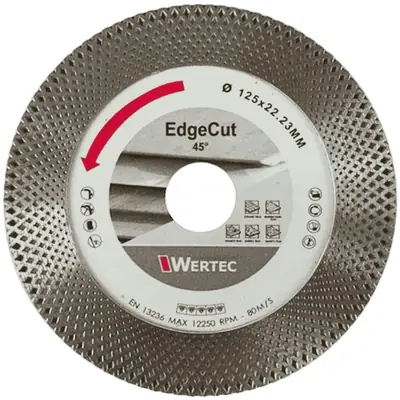
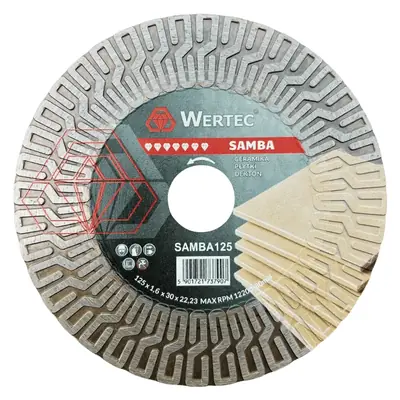
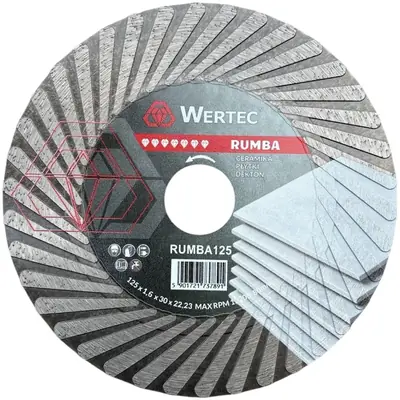
The 125 mm 45° blades – EDGECUT, SAMBA and RUMBA – cut and grind the edge at 45° with an ordinary 125 mm angle grinder (EDGECUT wet or dry). It is the fastest method for single corners on site. It needs a steady hand: the operator holds the angle, so on longer edges it pays to work with a guide.
Method 2: the SLIDER 45 angle guide
The SLIDER 45 attaches to an angle grinder (neck up to 43 mm) and guides it at a constant 45° along the tile edge. The guide holds the angle, not your hand – so the mitre is even along the whole length. It can also be used wet once a water supply is connected.
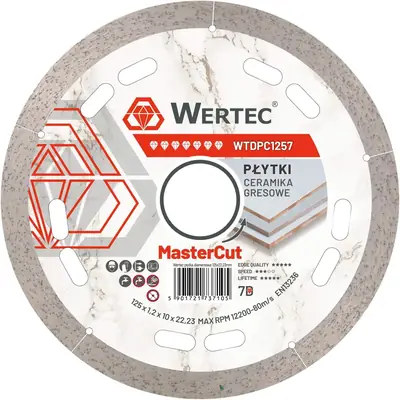
Cut the straight piece before mitring with a blade that leaves a clean edge – see diamond blades for porcelain.
Finishing the edge
- Do not grind to a knife edge. Leave about 1 mm of straight edge at the glaze – a sharp edge chips during fixing and grouting.
- Smooth the bevel with diamond polishing discs in successive grits: start with 50, then 100 and 200; on polished tiles finish with 400. Do not skip grits, or the scratches of the coarser disc stay visible.
- Without a machine, use a diamond polishing bar: grit 60, then 100 and 200, along the edge with light pressure and water – for short edges and small chips.
- Dry-fit the corner before applying adhesive: hold both tiles together and check the joint against the light.
Common mistakes
- Feeding too fast – chipped glaze.
- An overheated edge – burn marks on the glaze that cannot be removed. Work lightly and with breaks.
- A freehand mitre on a long edge – the angle drifts; use a guide.
- A bevel ground to zero – the edge crumbles at the first knock.
Frequently asked questions
What do I use to cut tiles at 45 degrees?
An angle grinder with a 45° blade (EDGECUT, SAMBA or RUMBA 125 mm) or a grinder with the SLIDER 45 angle guide. The choice depends on the number of corners and the length of the edges.
Can I mitre tiles with an ordinary angle grinder?
Yes – with a 45° blade. On longer edges an angle guide helps keep a constant angle.
Can every tile be mitred?
Through-body porcelain works best. On tiles glazed only on the surface, the mitred edge has a different colour from the face.
How much edge should I leave?
About 1 mm of straight edge at the glaze. A bevel ground to a knife edge chips easily.