Drilling porcelain tiles: core bits and technique
Porcelain is very hard and absorbs almost no water – an ordinary tile drill slides on it and goes blunt in seconds. Porcelain needs a diamond core bit. And because a cracked tile next to a socket or tap means replacing it, the bit is chosen for the material, diameter and machine – and the hole is drilled in the right order, not by force.
How a diamond core bit works
A core bit does not drill like a twist drill – it grinds. Diamond grains on the rim abrade the material around the circumference, and the centre stays as a core. Hence two basic rules: no hammer action and no pressure. Hammer action knocks diamond out of the rim and can crack the tile; too much pressure overheats the rim and shortens its life.
Mounting: angle grinder or drill
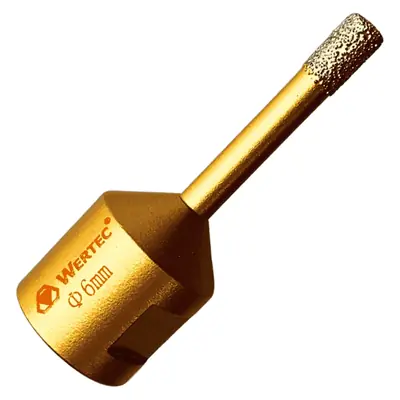
- M14 – the bit screws directly onto the angle grinder spindle. Higher speed and better control from about a dozen millimetres upwards. Most vacuum-brazed WERTEC core bits have an M14 thread – see diamond core bits.
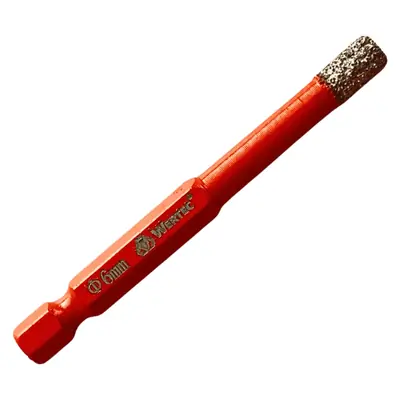
- HEX shank – for drills and drivers, typically small diameters for wall plugs: HEX core bits.
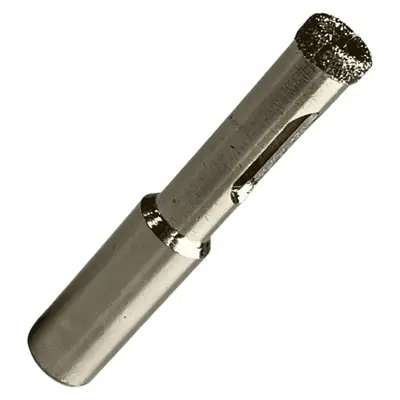
- Electroplated – for drills without hammer action, used with water. The diamond layer is thin, so they suit occasional holes rather than series work: electroplated core bits.
Which diameter
For an 8 mm wall plug take an 8 mm bit. For a pipe leave a few millimetres of clearance for the seal. A standard flush-mounted electrical box needs a 68 mm hole. A hole can be widened later – but never made smaller.
Which series
- Vacuum-brazed (WTA, MATRIX, BLUE) – diamond brazed to the body; fast cutting in porcelain, sintered stone, stone and wall tiles, for everyday work.
- TurboSpeed – turbo rim for faster drilling with acceptable edge quality; good where a rosette or cover hides the hole.
- Electroplated (WTB) – for occasional holes with a drill, with water.
- Drill-and-grind (WTAR) – a core bit you can also use to correct and widen a hole.
Step by step
- Mark the centre and check that the hole is not right at the tile edge – that is where tiles crack most easily. If you can, drill before fixing, with the tile lying flat on a firm base.
- Switch off hammer action – rotary drilling only.
- Start at an angle: hold the bit at about 30–45° until it cuts a crescent in the glaze, then gradually bring it upright. This way it will not wander on the smooth surface.
- Cool it: overheated diamond loses its edge within seconds. Wet the spot (sponge, spray bottle) or use bits made for dry drilling – and drill with breaks.
- Circular motion: with larger diameters rock the bit gently around the circumference so the slurry can escape and the bit does not jam.
- No force: light, even pressure. If the bit stops progressing, it is overheated or clogged – cool and clean it.
- Slow down at the end: go through the last millimetres without pressure so you do not break out the back of the tile.
Tile already on the wall: first the tile, then the wall
Drill only the tile with the porcelain core bit. Once you are through, switch to a masonry or concrete drill – only then may you use hammer action, and only if the drill does not touch the edge of the hole in the tile.
Common mistakes
- Drilling with hammer action – a cracked tile and lost diamond.
- A wet-only bit used dry – a burnt rim after one hole.
- Strong pressure and too high speed with large diameters – overheating.
- A hole at the edge without support – chipping.
- A porcelain core bit in concrete – the bit loses its diamond; for concrete use a masonry drill or a core drill.
The most used sizes in one case: diamond core bit sets.
Frequently asked questions
Which core bit for an electrical box in porcelain?
A standard flush box needs a 68 mm hole. Choose a 68 mm diamond core bit with an M14 thread and drill with an angle grinder without pressure.
Can I use a hammer drill?
Yes, but with hammer action switched off. Hammer action knocks out the diamond and can crack the tile.
Dry or wet?
Wet, the bit lasts longer and makes less dust. Dry, use bits made for dry drilling, take breaks and do not press.
How many holes will one core bit drill?
There is no single number – tile hardness, cooling and pressure decide. A bit that is cooled and used without pressure drills many more holes.