Which diamond blade for porcelain tiles?
A blade for porcelain is chosen for three things: the material, the machine and the cutting method – dry or wet. Price and a “premium” label come last.
How a diamond blade cuts
The work is done by diamond: its grains grind the material, and a metal bond holds them in the rim. The bond slowly wears and exposes new, sharp grains. Choosing a blade means matching this wear rate to the material – which is why a blade that cuts porcelain smoothly wears out quickly on brick, and a concrete blade on porcelain soon starts to glaze and stops cutting.
1. Material: hard or abrasive
The key rule: hard material needs a soft bond, abrasive material needs a hard bond. These are two different properties and must not be confused.
- Porcelain stoneware and sintered stone are hard and dense but not very abrasive. They need a blade with a soft, self-sharpening bond; a bond that is too hard does not wear, the diamond goes blunt and the blade glazes. See diamond blades for porcelain.
- Wall tiles and ceramics are softer than porcelain. A porcelain blade cuts them easily, and a thin continuous rim gives the cleanest edge on the glaze.
- Brick, blocks, fresh concrete and asphalt are abrasive and strip the bond – a porcelain blade loses its rim after a few cuts. Use a blade made for these materials.
- Sintered stone is cut like porcelain, but more carefully: it is hard and brittle, so a thin continuous rim with a soft bond works best – ideally wet and without pressure.
2. Machine: diameter, bore, speed
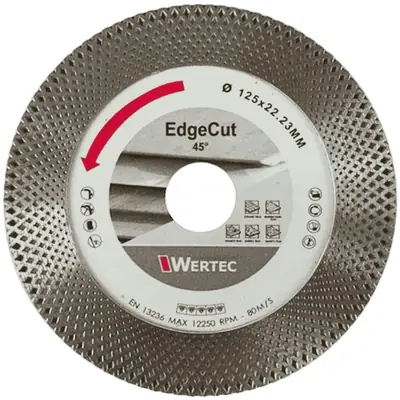
- 125 mm angle grinder – 125 × 22.23 mm blade, the most common choice for cutting porcelain on site.
- 115 mm angle grinder – 115 × 22.23 mm blade; check the guard before buying.
- Speed – the maximum speed printed on the blade must not be lower than the machine's speed; for 125 mm blades it is typically about 12,200 rpm. A machine that is too fast risks the blade breaking, not just wearing faster.
- Direction – the arrow on the blade must match the spindle rotation.
Bevelling tile edges at 45° is a separate job: it needs 45° blades, not an ordinary cutting blade.
3. Dry or wet
- Wet: water cools the blade, flushes out the slurry and binds the dust. The blade lasts longer and the edge is cleaner.
- Dry: use only blades the manufacturer marks for dry cutting. Turbo and segmented rims shed heat better, but there are also continuous rim blades approved for dry cutting.
- Cut in sections: lift the blade out of the cut regularly and let it spin in the air – that cools it fastest. Never put a hot blade into water, the core can crack.
- Dust: dry cutting porcelain produces silica dust. Work with extraction and a dust mask, preferably FFP3.
Signs of overheating: discoloration on the core, a burning smell, a constant shower of sparks, dark burn marks on the tile edge. The answer is less pressure and a break – not pushing harder.
How to tell the blade is wrong
- The blade shines, sparks and cuts more and more slowly – the bond is too hard for the material and the diamond has glazed. A few cuts in an abrasive material such as brick strip the top layer of bond; in the long run you need a softer bond.
- The rim wears away quickly – the bond is too soft, typically a porcelain blade used on concrete or blocks.
- Chipped glaze – feeding too fast, a blade that is too aggressive (turbo, segmented) or a worn rim.
- The tile breaks at the end of the cut – the off-cut is not supported or the feed is too fast. Take the last centimetres slowly.
- The blade wobbles – an overheated or deformed core, a wrong bore or flange. Stop using such a blade.
Frequently asked questions
Which blade for cutting porcelain dry?
A porcelain blade marked for dry cutting – continuous rim or turbo, usually 125 × 22.23 mm for an angle grinder. Cut in sections and let the blade cool while spinning.
How do I cut sintered stone?
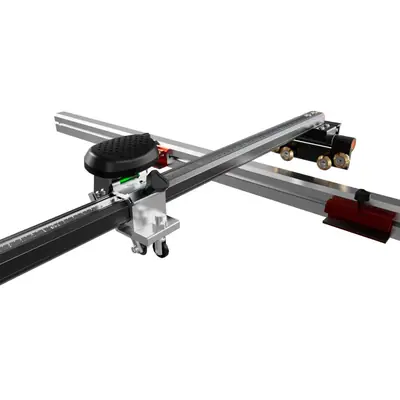
Like porcelain, but more carefully: a thin continuous rim with a soft bond, ideally wet and without pressure. For large slabs a work table and a cutting rail such as the T-Cutter help.
Can I cut porcelain with a concrete blade?
You can, but badly: the hard bond glazes quickly, the cut is slow and the tile edge chips.
How long does a porcelain blade last?
There is no single number. The material, tile thickness, cooling and pressure decide. The same blade used wet and without forcing lasts much longer than when cutting dry.