How to cut large-format tiles and sintered stone
With a small tile a mistake costs little; with a large format it costs a whole slab. Weight matters too: a 120×240 cm slab 6 mm thick weighs about 40 kg, thicker ones much more. So the cutting method is chosen together with the way you carry and lay the slab. There are three proven methods – each wins in a different job, and the most common mistake is using one for everything.
Method 1: wet table saw
It gives the cleanest edge, and the water cools the blade and binds the dust. Cuts are straight and repeatable – provided the machine's cutting length matches the slab. Limitations: the slab has to go onto the table, which for 120×240 means two people or suction cups; you need power and water; and you cannot trim a slab that is already fixed. Choose it when you cut series of slabs, have water and power on site and want an even, chip-free edge.
Method 2: angle grinder with a guide (dry)
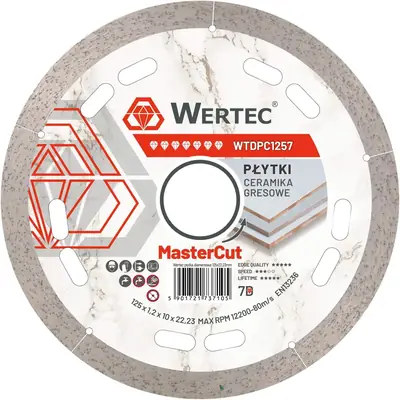
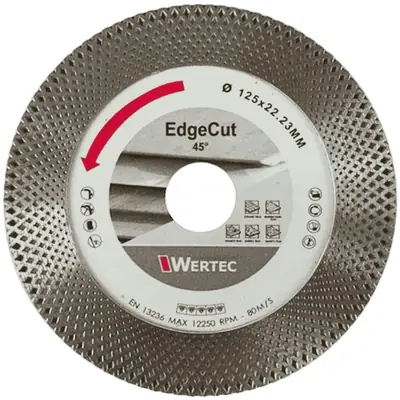
The guide keeps the grinder in line, and a porcelain diamond blade does the rest. It is mobile, quick to set up and you cut where the slab lies – good for angled cuts, cut-outs and trims at the wall. The price is dust (a lot of it), noise and an edge that often needs finishing. On long cuts watch your pace: forcing the blade ends in chipping and overheating.
Method 3: cutting rail with a breaker (dry, no power)
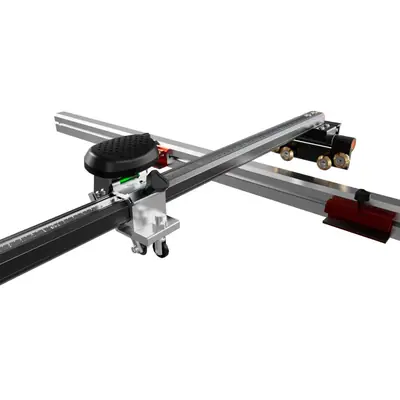
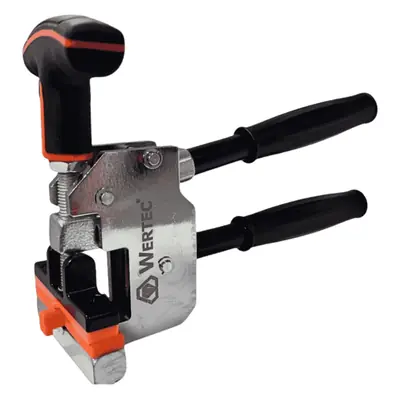
The simplest method: you score the glaze with a wheel guided along the rail, then snap the slab with a breaker. No power, no water, no dust. It is the basic way to make long straight cuts across the whole slab, including thin sintered stone – see the T-Cutter cutting rails and the large-format breakers. Limitations: a snapped edge is less even than a sawn one, so finish it where it will be visible; heavily structured surfaces are harder, because the wheel does not run in an even score line.
Cutting with a rail, step by step
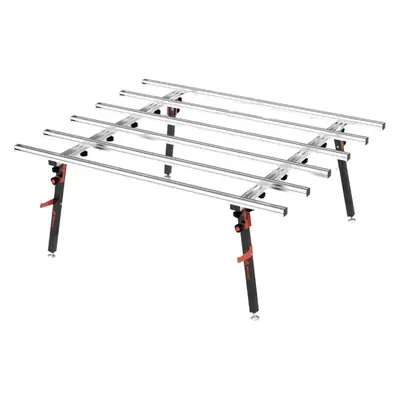
- Lay the slab on a flat, stable surface – a large-format work table works best. The face must not lie on anything that can scratch it.
- Mark the line and set the rail exactly along it. The rail must not move while you score.
- Score in one pass of the wheel, edge to edge, with even pressure over the whole length. Do not correct the score with a second pass – re-scoring causes chipping and a crooked break.
- Snap the slab: set the breaker on the score line at the edge of the slab; on long cuts break from both ends. The slab breaks along the score only when the pressure acts exactly on its line.
- Finish the edge where it will be visible, e.g. on skirtings or corners, with diamond pads and light pressure.
Common mistakes
- The slab breaks in the wrong place – usually an interrupted or uneven score, or breaker pressure off the line.
- Chipping with the grinder – feeding too fast or a blade not made for porcelain.
- The blade jams in a table saw – an unsupported slab bends and pinches the blade; support it along the whole length.
- Cracks at the corners of cut-outs – for L-shaped cut-outs drill a hole at the corner first; a sharp internal corner is where cracks start.
And sintered stone?
Sintered stone is harder and denser than ordinary porcelain and tolerates haste less. Thin slabs are scored and snapped with a rail just like large-format porcelain. Thicker ones are best cut wet, with a blade made for sintered stone and a slow feed. Use a dry grinder only for short trims, with breaks, so you do not overheat the material – overheating risks micro-cracks at the edge.
On site, slabs are moved vertically on edge – a trolley such as the WT704, with a brake on each wheel, makes it safer.
Frequently asked questions
What is the best way to cut large-format tiles?
It depends on the job: a table saw gives the cleanest edge for series, a grinder with a guide wins for trims and cut-outs, and a rail with a breaker is the fastest way to make long straight cuts without power.
How do I cut a 120×240 slab without a table saw?
With a large-format cutting rail and a breaker: one score with the wheel, then snap the slab on the score line. Make cut-outs and trims at the wall with a grinder and a guide.
Can sintered stone be cut dry?
Thin sintered stone can be scored with a rail and snapped. Limit dry cutting with a blade to short trims, with breaks. Cut thick slabs wet.
Why does the tile break when snapping?
Most often because the score is interrupted, uneven or corrected with a second pass, or the breaker presses beside the line. A crack always follows the weakest point.