Laser level for tiling: green or red, 3D or 4D?
A line laser does not lay tiles for you, but it replaces the string line, the long spirit level and the pencil in dozens of places at once. Two questions decide the choice: the colour of the beam and how many lines you really need.
Green or red beam
For tiling indoors choose a green beam: the human eye sees a green line much brighter than a red one, so in daylight and on light walls the line does not disappear. A red laser is cheaper and runs longer on its batteries, but in practice it works only in darker rooms and over short distances. All WERTEC line lasers have a green beam; most models have batteries of 4000 mAh or more, and some sets come with two batteries.
What 2, 12 and 16 lines mean
A “line” is one visible stripe on a surface. A 360° plane gives four such lines, one on each wall – hence 12 lines from three planes (3D) and 16 lines from four (4D).
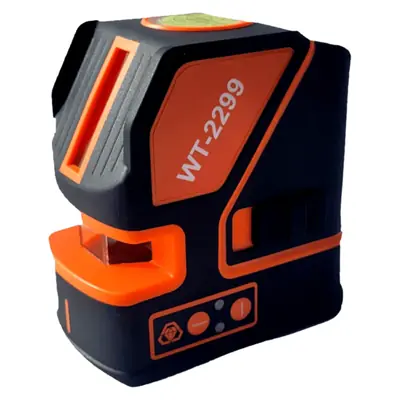
- 2 lines (cross-line laser) – enough for one wall: the level of the first row and a plumb line. Example: WT-2299, range 15 m.
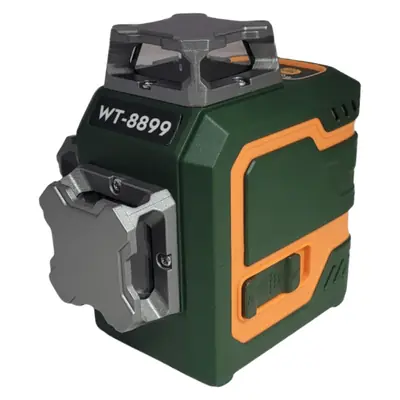
- 12 lines (3D) – three 360° planes: the level and two plumb lines around the room, e.g. WT-8899.
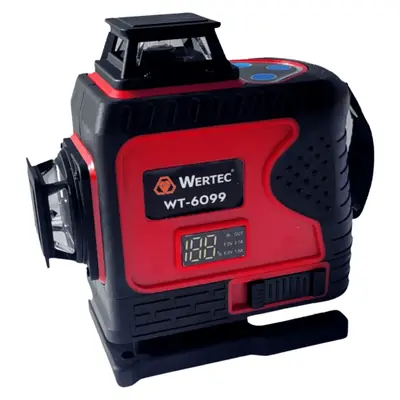
- 16 lines (4D) – four 360° planes: level, plumb lines and lines on the floor at the same time; the standard for bathrooms and large formats: WT-6099, WT-5899/B, WT-8799 and WT-6699S.
What a tiler uses the laser for
- A reference level around the room – one horizontal line on all walls at once, from which you measure the height of the first row, skirting or niche shelf.
- The first row without a batten – with large formats this row decides everything, and the line on the wall replaces a screwed-on batten.
- Plumb lines in corners and at windows – you see at once whether the wall runs off and where tiles will need trimming.
- A cross on the floor – the room axis and a right angle in seconds. This is where a 4D laser, which also projects lines on the floor, helps.
- Falls and linear drains – the laser shows the reference level from which you measure the fall; it does not set the fall itself.
3D or 4D?
3D (12 lines) is enough if you mainly tile walls, need level and plumb lines in the whole room at once, and want a lower price and weight. Choose 4D (16 lines) if you work a lot on floors and with large formats, want lines on walls and floor at the same time without moving the laser, or do whole bathrooms from floor to ceiling. A cross-line laser is a good second laser, or a first one for single walls.
Range and accuracy
Indoors, a range of 15–25 m without a detector is enough. An accuracy of ±0.2 mm/m means the line may deviate by at most 1 mm on a 5 m wall – less than a typical joint. A longer range (up to 40 m with the WT-8799 and WT-6699S) helps in halls, on terraces and in long corridors.
When you need a detector
Outdoors and in very bright halls even a green line is hard to see. Then a detector helps: it picks up the beam in pulse mode and shows its position on a staff or wall. The WT-DET01 detector works with the WT-5899/B and WT-5899/W, among others, but not with the WT-6699S. Before buying, check in the laser's manual that it has a detector mode.
Check that the laser holds level (2 minutes)
- Place the laser 4–5 m from a wall and mark the centre of the cross on it.
- Turn the laser by 180° so it faces the opposite wall and mark a point there.
- Move the laser close to the second wall and repeat both measurements.
- If the height differences of the marked points on both walls are within the accuracy stated in the manual, the laser is fine. If not, do not work by eye – have it calibrated.
Frequently asked questions
Is a green laser better for tiling than a red one?
Yes – a green line is much more visible in daylight and on light surfaces. A red laser is cheaper and runs longer on its batteries, but in a bright room the line easily disappears.
How many lines does a tiling laser need?
A 2-line cross laser is enough for one wall. For a whole bathroom a 3D (12 lines) or 4D (16 lines) laser is better, as it projects lines around the room and onto the floor.
What accuracy does a tiler need?
±0.2 mm/m means about 1 mm deviation over 5 m – enough for laying tiles, including large formats.
Why do the laser lines flash?
The laser is tilted beyond its self-levelling range. This is a safety feature, not a fault – set the laser more level and the lines stop flashing.